
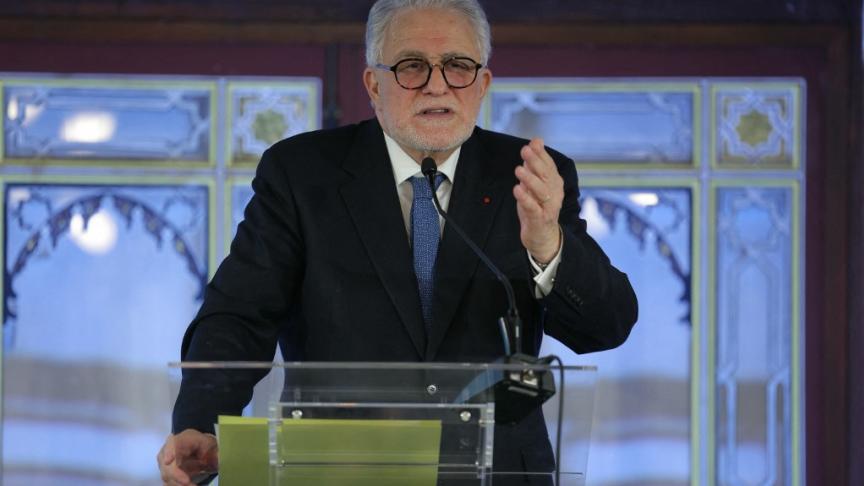
On Thursday, during his New Year’s speech, the rector strongly denounced “a scandalous and unfounded cabal” and “an unprecedented media campaign.”
The cause: a recent article in the newspaper L’Opinion accusing the Great Mosque of Paris of having organized, with the support of Algerian authorities, a monopolistic halal certification system for European products destined for Algeria.
According to the newspaper, the system would resemble “an obligatory tax” and would be highly profitable, with an expected turnover of 5 million euros in 2024.
After this article, right-wing MEP François-Xavier Bellamy alerted the European Commission, and far-right MP Matthias Renault announced he would contact the prosecutor in Paris, denouncing a system that, according to him, “could amount to extortion.”
These arguments were refuted by Chems-eddine Hafiz, who insists on the transparency of this system, which is managed by a commercial company affiliated with the Great Mosque.
“Everything was made public” as soon as the agreements were signed with the Algerian authorities in December 2022, he assured. “All dividends go toward funding the practice of the Muslim faith.”
“Today, coincidentally, everything is bad. There is a specific context between Algeria and France, and we can see how my opponents are attacking me,” he added.
This affair occurs in a tense diplomatic context: “The Great Mosque of Paris is a collateral victim of the deterioration of relations with Algiers,” says Franck Frégosi, a researcher at the CNRS (National Center for Scientific Research) and author of Gouverner l’islam en France (Seuil).
Inaugurated in 1926, the Great Mosque has benefited from annual funding of about 2 million euros from the Algerian state since the early 1980s, and all of its rectors have been born in Algeria. This has led to the recurring accusation—denied by Chems-eddine Hafiz—that it is a “second embassy of Algeria.”
“The rector is caught in this maelstrom: on one hand, it is well known that the Great Mosque of Paris is a strong link to the Algerian state in France, and at the same time, he strives to appear as the most credible and moderate interlocutor within Islam in France,” adds Franck Frégosi.
A Franco-Algerian lawyer, Chems-eddine Hafiz has often denounced Islamism, launched a literary prize, reflected on “the adaptation of Muslim discourse in France,” and recently called on his 150 imams for an “invocation for France” at the end of Friday prayers.
But other well-informed sources are more critical: “Some believe the man speaks with a double discourse. By constantly trying to straddle two positions, one eventually ends up hurting their inner thighs,” says one of them.
In early January, Chems-eddine Hafiz had already denounced an “intolerable defamatory campaign” from the conservative channel CNews after the influencer Chawki Benzehra called him live on air an “influence agent of the Algerian regime” working on “a campaign to destabilize France.”
For another expert on Islam in France, Chems-eddine Hafiz “is the victim of an industrial accident represented by Boualem Sansal,” the Franco-Algerian writer who has been imprisoned in Algeria since mid-November, and “he can only emerge from this ambiguity at his own expense.”
“He is cornered because he sees that he is losing the credibility he once had. He had become the figurehead of Islam in France,” adds this observer.
Since the executive broke with the French Council of the Muslim Faith (CFCM) at the end of 2021—paralyzed by internal opposition and suffering from a lack of legitimacy—the rector of the Great Mosque has become the preferred interlocutor of the public authorities.
For behind the scenes, this also raises the question of the representation of France’s second-largest religion.
On January 20, in L’Opinion, Chems-eddine Hafiz assured he had never met “personally” with Interior Minister Bruno Retailleau. “He pretends that the Great Mosque of Paris does not exist,” he lamented.
(Source : AFP)